
These are my opinions only. (5) Minutes read)
“The price for First Nations [DRIPA] approval [of applications for leases and licenses] could be an increasing share of royalties and kickbacks, without which consent will be refused. Both governments and First Nations will siphon an ever-larger piece of a shrinking pie.” (“B.C. plans to ‘reconcile’ by giving First Nations veto on land use”, “ Bruce Pardy, Fraser Institute, Feb 1, 2024
Despite their claims to be protectors and stewards of the land, based on media reports, it appears UN DRIP Nations are not a superior people with a special connection to the land: they are as susceptible to the corruption that comes with unregulated power by unelected people as anyone.
Today’s UN DRIP Nations (the United Nations laws for the Declaration on the Rights of Indigenous People) are “not your grandma’s” First Nations. They are not fellow Canadians with shared values that most Canadians knew and loved.
However, the former First Nations pre-DRIPA serve as an avatar for the globalist United Nations and Democrat (to be clear for anyone suffering from TDS) American funded organizations like “Coastal First Nations”- which is not a First Nations nation at all.
And that former First Nations avatar plays a central role in the UN DRIP Nations behind closed-door meetings and under-the-radar court proceedings allowing them to gain this special status to approve or withhold approval of environmental projects:
“For Indigenous communities, the connection with the land runs deep, akin to a familial bond that informs their sacred stewardship practices. It’s a relationship built on reverence and reciprocity, where the land is not merely a resource but a living entity deserving of respect and care. They stand as the original stewards, guardians, and protectors of the land.” Indigenous People’s Day, Honouring Indigenous Stewardship, Jun 19, 2024
It appears increasingly that Canadian environmentalists and agencies have to protect our land from the United Nations DRIP Nations’ for-profit ecological damage. Here are two examples that have surfaced just in the last month.
Cowichan UN DRIP Nation: Thanks to a local Canadian neighbour’s years of persistence, it finally surfaced in a November 2025 Global News report that a Cowichan DRIP Nation band member has been allowing toxic construction materials to be dumped, not just anywhere which is bad enough, but specifically in and around the banks of the ecologically protected fish bearing Cowichan River. Thanks to Global News for covering this story on video twice, here and here. Global News has only reported very positively on First Nations in my experience so the coverage and courage to report this deserves some kind of award.
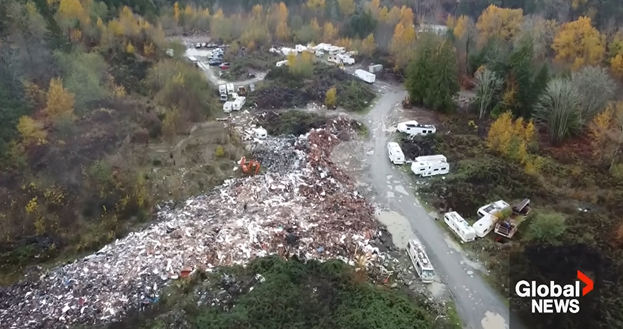
This is the same Cowichan DRIP Nation that presented themselves in the (under appeal) Cowichan land claims case as having title to both public and private land owners’ land in Richmond because centuries ago they had a fishing village on the Fraser River.
Canadian taxpayers must now pay upwards of between $1 to $5 million dollars to remediate the Cowichan River to save the fish and wildlife that must be protected from consuming the toxic materials and plastics, etc. that have been dumped by the Cowichan band member.
Criminal charges were laid but then stayed, apparently without explanation, against the Cowichan band member to the frustration of local environmentally concerned neighbours who saw and reported it happening for years. Apparently, the Cowichan band itself is not facing criminal charges.
Why would the “keepers of the land” with a claim to have a special connection to the sanctity of the land and waters do such an unbelievable ecologically damaging act, for profit?
The Cowichan, the so-called protectors of the land say (in dispute) that it is the federal and provinces who have to spend the money to protect the land – even on Cowichan tribe land. It appears the Cowichan were playing hard ball all those years: give us more Canadian tax dollars or we will approve, or turn a blind eye to, our Cowichan band member dumping toxic materials into Canadian fish bearing waters, for profit.
Mowachaht/Muchalaht Nation: “Why was ‘incredible’ giant cedar cut down, despite B.C.’s big-tree protection law?” (Canadian Press, December 4, 2025 in old growth area that is majority owned by Mowachaht/Muchalaht First Nation
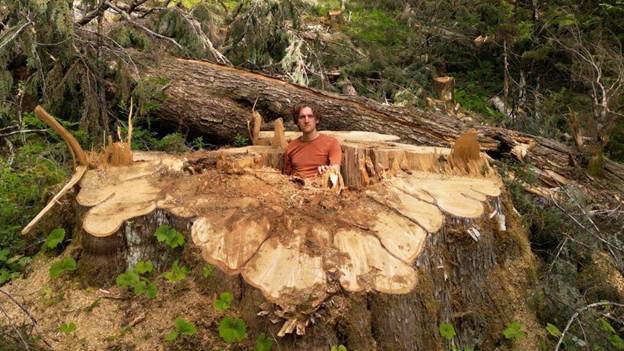
In December 2025 the Canadian Press reported a rare, centuries old tree that had been marked for protection was cut down on majority owned Mowachaht/Muchalaht Nation land:
“Rachel Holt, an independent ecologist who has advised the British Columbia government, said it is “very disturbing to see example after example” of forests with the oldest, biggest trees continue to be logged, especially those identified as containing the most at-risk and irreplaceable old-growth left in the province.” This is off the charts, globally rare stuff…
Holt served on a provincial advisory panel that identified much of the area [majority owned by Mowachaht/Muchalaht First Nation] as “big-treed” old growth and recommended [Mowachaht/Muchalaht First Nation] [approve its deferral from logging in 2021].
Why would the keepers and protectors of the land cut down such a globally rare and protected tree? They withheld their approval to protect the tree because they did not receive what they considered sufficient Canadian taxpayer money to protect the tree. It was worth more to cut it down:
Yet the deferrals [to protect the big-treed old growth area were not approved by the Mowachaht/Muchalaht First Nation because] at the time, there was no significant funding to help [the Mowachaht/Muchalaht First Nation] offset [their] foregone revenues [so they cut it down for profit.]
The province announced a $300-million conservation financing fund in the fall 2023, saying it was aimed at ‘accelerating protection of B.C.’s oldest and rarest trees.’ But Holt said forests identified as priority for deferral continue to be logged…Representatives of Mowachaht/Muchalaht First Nation did not respond to requests for comment on the logging operation.”
Mining Projects: Also in December 2025, the British Columbia courts gave further powers to approve or withhold approval to the UN DRIP Nations who must now be consulted on mining projects.
Even UN DRIP Nations’ Chief ally David Eby is nervous minimally calling for DRIPA to be amended, but resisting the loud calls for it to be repealed and stop the madness and damage being wrought on British Columbia – perhaps irreparably, like the old growth forests.
You must be logged in to post a comment.