Notice to Researchers and Public Observers:
The text below is a verbatim transcription of the official Oral Reasons for Judgment delivered by Mr. Justice Cullen on January 16, 2007 (Docket: S025856, Vancouver Registry). This ruling was issued during a specialized Voir Dire proceeding held to determine the admissibility of evidence for the trial.
While the Court of Appeal ultimately determined that files submitted to the university Senate sub-committee were protected by a retroactive cloaking of absolute immunity (preventing them from forming the basis of a civil defamation lawsuit inside a courtroom), the historical reality of the text remains a matter of unedited public record.
As recorded explicitly by the Supreme Court of British Columbia in paragraphs (16) and (17) of this judgment, the formal university Senate Appeals Committee itself officially characterized the faculty’s response to the student’s fact-based research paper as an “irrelevant and unseemly attack upon character for mental and emotional stability and for religious tolerance,” declaring the institutional retaliation to be “inexcusable.”
This transcription is preserved here strictly for historical transparency, public accountability, and to document the systemic legal mechanics of how institutional immunity operates under the University Act.
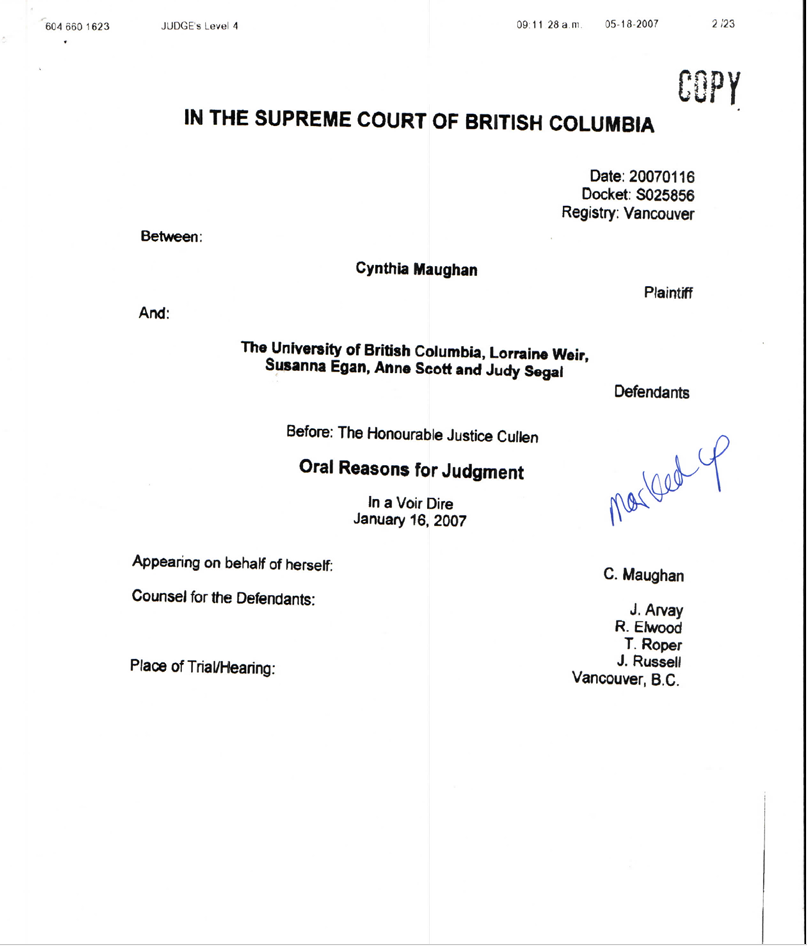
Exhibit: BCSC Oral Reasons for Judgment (Evidence Exclusion)
IN THE SUPREME COURT OF BRITISH COLUMBIA
Date: 20070116
Docket: S025856
Registry: Vancouver
Before: The Honourable Justice Cullen
Between: Cynthia Maughan (Plaintiff)
And: The University of British Columbia, [Defendant Professor 1], [Defendant Professor 2], [Defendant Professor 3], and [Defendant Professor 4] (Defendants)
(Page 6) – The Senate’s Finding of an “Inexcused Character Attack”
(14) It is Ms. Maughan’s contention that the content of the documents sent by [ comprising what has been called the “Defendant Professor 1]Defendant Professor 1 Report”, and the [] and the Defendant Professor 2[ letters reflect ongoing discriminatory conduct towards her…Defendant Professor 3]
(16) A hearing was conducted into Ms. Maughan’s appeal on April 10, 2001, by the Senate Appeals Committee. The committee rendered its decision on April 24, 2001, dismissing her grade appeal. In the course of its reasons, the appeal committee was sharply critical of the “Department of English” in mounting “an irrelevant and unseemly attack upon (Ms. Maughan’s) character for mental and emotional stability and for religious tolerance.”
(17)The committee noted that the attack was “inexcusable even though it arose in the context of an unusually acrimonious appeal…”
(18) The defendants take the position that the documents which Ms. Maughan wishes to place before the court respecting the appeal to the Senate committee are inadmissible because they are subject to an immunity that cloaks any communications which are incidental and proximate to quasi-judicial or judicial proceedings for reasons of public policy.
(Page 10) – Declaring the Committee “Quasi-Judicial”
(27) I conclude that in light of the reasoning in Harelkin and Polten… that the authority exercised by the Senate committee in the context of this case in responding to the plaintiff’s grade appeal was quasi-judicial in nature.
(Page 14 & 15) – Protecting Malice and Bad Faith
(42) As I see it, much flows from the quasi-judicial nature of the Senate appeal process. The law has developed a strong defence against any potential compromise of the freedom of expression with which parties and their witnesses are encouraged to approach the resolution of disputes… the object of immunity is the protection of the process through the protection of the parties’ and their witnesses’ utterances, not the protection of the parties or the witnesses themselves.
(45)I am also satisfied even the presence of malice or bad faith does not vitiate the immunity imposed by law upon the statements or evidence of the parties or their witnesses. Thus whatever the veracity of the statements at issue or the motive or intention behind them, they are not fertile ground for launching or sustaining a collateral action.
(46) I am further satisfied that the primary documents at issue, that is the [1Defendant Professor ] report, the [2Defendant Professor ] letter, the [ letter and the Defendant Professor 3][M] letter were all documents which were incidental and proximate to the hearing…
You must be logged in to post a comment.