[Exhibit Page: 982]
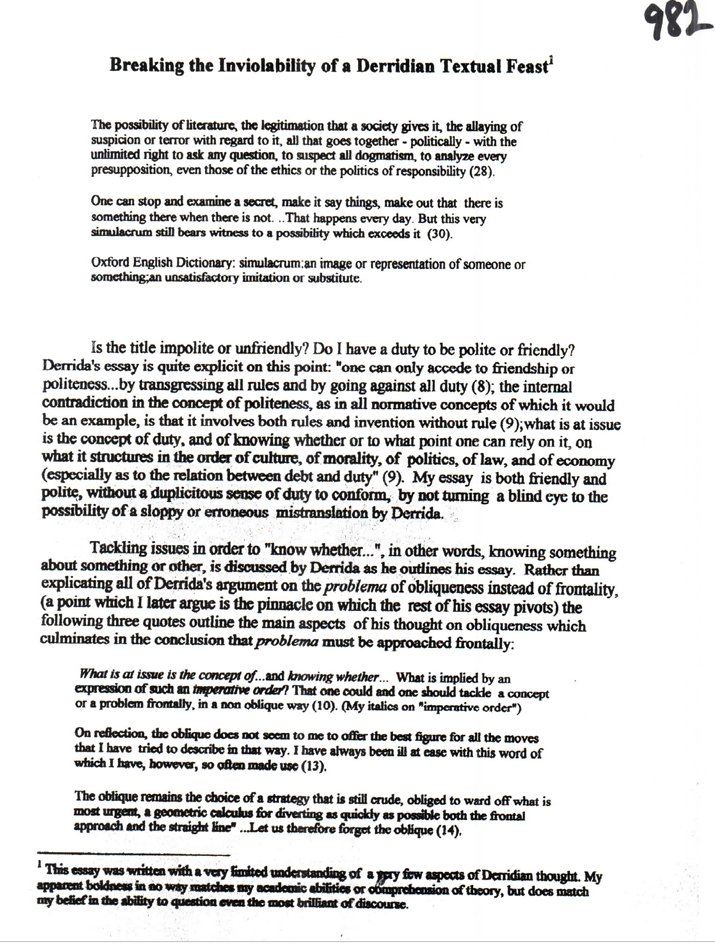
Breaking the Inviolability of a Derridian Textual Feast¹
The possibility of literature, the legitimation that a society gives it, the allaying of suspicion or terror with regard to it, all that goes together – politically – with the unlimited right to ask any question, to suspect all dogmatism, to analyze every presupposition, even those of the ethics or the politics of responsibility (28) (p. 28).
One can stop and examine a secret, make it say things, make out that there is something there when there is not. ..That happens every day. But this very simulacrum still bears witness to a possibility which exceeds it (30) (p. 28).
Oxford English Dictionary: simulacrum: an image or representation of someone or something; an unsatisfactory imitation or substitute (p. 28).
Is the title impolite or unfriendly? Do I have a duty to be polite or friendly? Derrida’s essay is quite explicit on this point: “one can only accede to friendship or politeness… by transgressing all rules and by going against all duty (8); the internal contradiction in the concept of politeness, as in all normative concepts of which it would be an example, is that it involves both rules and invention without rule (9); what is at issue is the concept of duty, and of knowing whether or to what point one can rely on it, on what it structures in the order of culture, of morality, of politics, of law, and of economy (especially as to the relation between debt and duty” (9) (p. 28). My essay is both friendly and polite, without a duplicitous sense of duty to conform, by not turning a blind eye to the possibility of a sloppy or erroneous mistranslation by Derrida (p. 28).
Tackling issues in order to “know whether…”, in other words, knowing something about something or other, is discussed by Derrida as he outlines his essay (p. 28). Rather than explicating all of Derrida’s argument on the problema of obliqueness instead of frontality, (a point which I later argue is the pinnacle on which the rest of his essay pivots) the following three quotes outline the main aspects of his thought on obliqueness which culminates in the conclusion that problema must be approached frontally (p. 28):
What is at issue is the concept of… and knowing whether… What is implied by an expression of such an imperative order? That one could and one should tackle a concept or a problem frontally, in a non oblique way (10) (p. 28). (My italics on “imperative order”) (p. 28)
On reflection, the oblique does not seem to me to offer the best figure for all the moves that I have tried to describe in that way (p. 28). I have always been ill at ease with this word of which I have, however, so often made use (13) (p. 28).
The oblique remains the choice of a strategy that is still crude, obliged to ward off what is most urgent, a geometric calculus for diverting as quickly as possible both the frontal approach and the straight line” …Let us therefore forget the oblique (14) (p. 28).
¹ This essay was written with a very limited understanding of a very few aspects of Derridian thought (p. 28). My apparent boldness in no way matches my academic abilities or comprehension of theory, but does match my belief in the ability to question even the most brilliant of discourse (p. 28).
[Exhibit Page: 983]
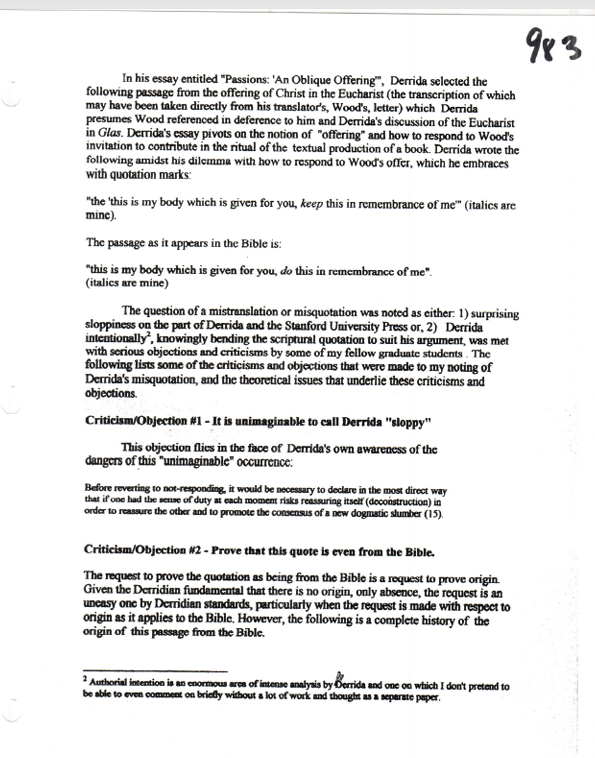
In his essay entitled “Passions; ‘An Oblique Offering'”, Derrida selected the following passage from the offering of Christ in the Eucharist (the transcription of which may have been taken directly from his translator’s, Wood’s, letter) which Derrida presumes Wood referenced in deference to him and Derrida’s discussion of the Eucharist in Glas. Derrida’s essay pivots on the notion of “offering” and how to respond to Wood’s invitation to contribute in the ritual of the textual production of a book. Derrida wrote the following amidst his dilemma with how to respond to Wood’s offer, which he embraces with quotation marks:
“the ‘this is my body which is given for you, keep this in remembrance of me'” (italics are mine).
The passage as it appears in the Bible is:
“this is my body which is given for you, do this in remembrance of me”. (italics are mine)
The question of a mistranslation or misquotation was noted as either: 1) surprising sloppiness on the part of Derrida and the Stanford University Press or, 2) Derrida intentionally², knowingly bending the scriptural quotation to suit his argument, was met with serious objections and criticisms by some of my fellow graduate students. The following lists some of the criticisms and objections that were made to my noting of Derrida’s misquotation, and the theoretical issues that underlie these criticisms and objections.
Criticism/Objection #1 – It is unimaginable to call Derrida “sloppy”
This objection flies in the face of Derrida’s own awareness of the dangers of this “unimaginable” occurrence:
Before reverting to not-responding, it would be necessary to declare in the most direct way that if one had the sense of duty at each moment risks reassuring itself (deconstruction) in order to reassure the other and to promote the consensus of a new dogmatic slumber (15).
Criticism/Objection #2 – Prove that this quote is even from the Bible.
The request to prove the quotation as being from the Bible is a request to prove origin. Given the Derridian fundamental that there is no origin, only absence, the request is an uneasy one by Derridian standards, particularly when the request is made with respect to origin as it applies to the Bible. However, the following is a complete history of the origin of this passage from the Bible.
² Authorial intention is an enormous area of intense analysis by Derrida and one on which I don’t pretend to be able to even comment on briefly without a lot of work and thought as a separate paper.
[Exhibit Page: 984]
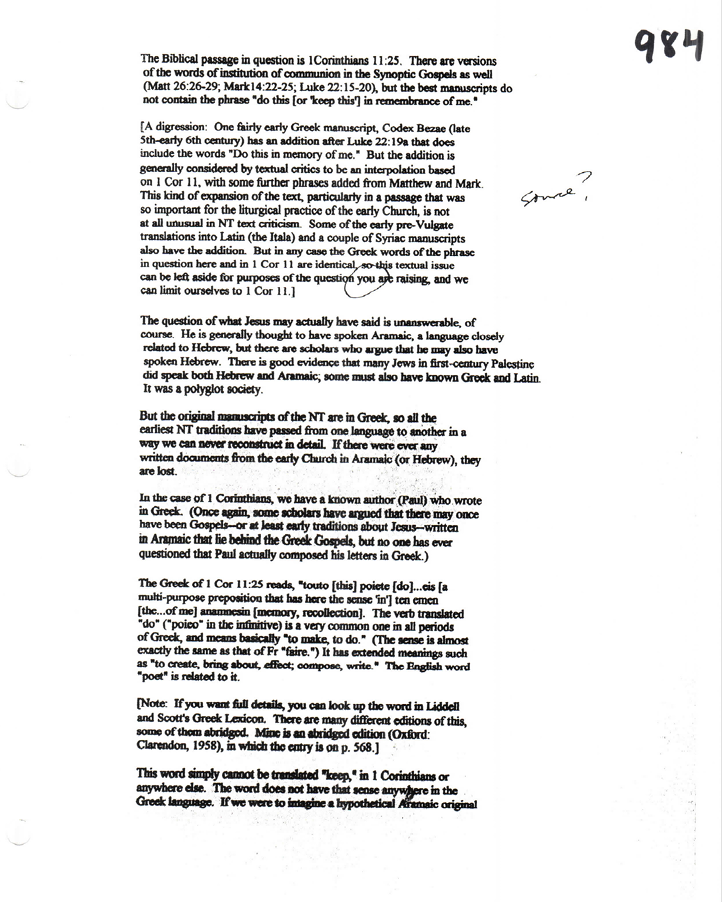
The Biblical passage in question is 1Corinthians 11:25. There are versions of the words of institution of communion in the Synoptic Gospels as well (Matt 26:26-29; Mark 14:22-25; Luke 22:15-20), but the best manuscripts do not contain the phrase “do this (or ‘keep this’) in remembrance of me.”
(A digression: One fairly early Greek manuscript, Codex Bezae (late 5th-early 6th century) has an addition after Luke 22:19a that does include the words “Do this in memory of me.” But the addition is generally considered by textual critics to be an interpolation based on 1 Cor 11, with some further phrases added from Matthew and Mark. This kind of expansion of the text, particularly in a passage that was so important for the liturgical practice of the early Church, is not at all unusual in NT text criticism. Some of the early pre-Vulgate translations into Latin (the Itala) and a couple of Syriac manuscripts also have the addition. But in any case the Greek words of the phrase in question here and in 1 Cor 11 are identical, so this textual issue can be left aside for purposes of the question you are raising, and we can limit ourselves to 1 Cor 11.)
The question of what Jesus may actually have said is unanswerable, of course. He is generally thought to have spoken Aramaic, a language closely related to Hebrew, but there are scholars who argue that he may also have spoken Hebrew. There is good evidence that many Jews in first-century Palestine did speak both Hebrew and Aramaic; some must also have known Greek and Latin. It was a polyglot society.
But the original manuscripts of the NT are in Greek, so all the earliest NT traditions have passed from one language to another in a way we can never reconstruct in detail. If there were ever any written documents from the early Church in Aramaic (or Hebrew), they are lost.
In the case of 1 Corinthians, we have a known author (Paul) who wrote in Greek. (Once again, some scholars have argued that there may once have been Gospels—or at least early traditions about Jesus—written in Aramaic that lie behind the Greek Gospels, but no one has ever questioned that Paul actually composed his letters in Greek.)
The Greek of 1 Cor 11:25 reads, “touto (this) poiete (do)…eis (a multi-purpose preposition that has here the sense ‘in’) ten emen (the…of me) anamnesin (memory, recollection). The verb translated “do” (“poieo” in the infinitive) is a very common one in all periods of Greek, and means basically “to make, to do.” (The sense is almost exactly the same as that of Fr “faire.”) It has extended meanings such as “to create, bring about, effect; compose, write.” The English word “poet” is related to it.
(Note: If you want full details, you can look up the word in Liddell and Scott’s Greek Lexicon. There are many different editions of this, some of them abridged. Mine is an abridged edition (Oxford: Clarendon, 1958), in which the entry is on p. 568.)
This word simply cannot be translated “keep,” in 1 Corinthians or anywhere else. The word does not have that sense anywhere in the Greek language. If we were to imagine a hypothetical Aramaic original
[Exhibit Page: 985]
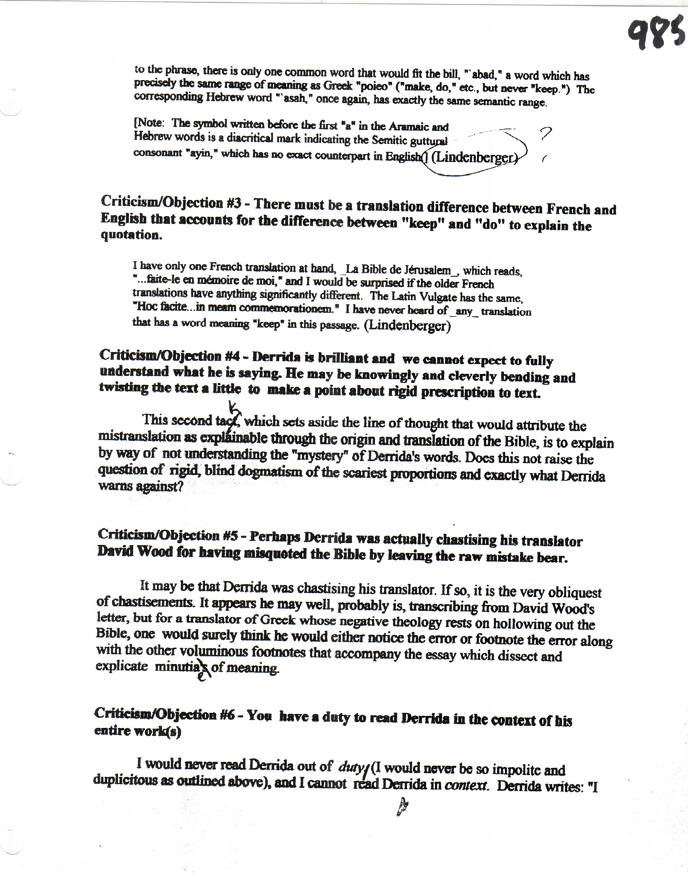
to the phrase, there is only one common word that would fit the bill, “‘abad,” a word which has precisely the same range of meaning as Greek “poieo” (“make, do,” etc., but never “keep.”) The corresponding Hebrew word “‘asah,” once again, has exactly the same semantic range.
[Note: The symbol written before the first “a” in the Aramaic and Hebrew words is a diacritical mark indicating the Semitic guttural consonant “ayin,” which has no exact counterpart in English] (Lindenberger)
Criticism/Objection #3 – There must be a translation difference between French and English that accounts for the difference between “keep” and “do” to explain the quotation.
I have only one French translation at hand, La Bible de Jérusalem, which reads, “…faite-le en mémoire de moi,” and I would be surprised if the older French translations have anything significantly different. The Latin Vulgate has the same, “Hoc facite…in meam commemorationem.” I have never heard of any translation that has a word meaning “keep” in this passage. (Lindenberger)
Criticism/Objection #4 – Derrida is brilliant and we cannot expect to fully understand what he is saying. He may be knowingly and cleverly bending and twisting the text a little to make a point about rigid prescription to text.
This second tact, which sets aside the line of thought that would attribute the mistranslation as explainable through the origin and translation of the Bible, is to explain by way of not understanding the “mystery” of Derrida’s words. Does this not raise the question of rigid, blind dogmatism of the scariest proportions and exactly what Derrida warns against?
Criticism/Objection #5 – Perhaps Derrida was actually chastising his translator David Wood for having misquoted the Bible by leaving the raw mistake bear.
It may be that Derrida was chastising his translator. If so, it is the very obliquest of chastisements. It appears he may well, probably is, transcribing from David Wood’s letter, but for a translator of Greek whose negative theology rests on hallowing out the Bible, one would surely think he would either notice the error or footnote the error along with the other voluminous footnotes that accompany the essay which dissect and explicate minutia of meaning.
Criticism/Objection #6 – You have a duty to read Derrida in the context of his entire work(s)
I would never read Derrida out of duty (I would never be so impolite and duplicitous as outlined above), and I cannot read Derrida in context. Derrida writes: “I
[Exhibit Page: 986]
shall try to demonstrate why a context is never absolutely determinable, or rather, why its determination can never be entirely certain or saturated” (“Signature Event Context”, 3)³
Criticism/Objection #7 – It is not essential to his argument and it was simply a mistake. Derrida would laugh at us focusing on such an insignificant error.
I think the “error” is essential to Derrida’s essay for the following reasons. Once again, the quote Derrida embraces with quotation marks is:
the ‘this is my body which is given for you, keep this in remembrance of me’, is this not the most oblique offering {don}?” (my italics added on the word “keep”).
1 – The pinnacle of Derrida’s subtitle, and the focus of his essay occurs at the point of the mistranslation.
The essay is entitled “Passions: ‘An Oblique Offering’. Derrida says about the scriptural passage from which he quotes and substitutes “keep” for “do”: “is this not the most oblique offering (don)?” Clearly the idea of “offering” is significant to what Derrida is saying or else he wouldn’t have subtitled, or (to appease the most rigid of objectors) accepted the sub-title of his essay with the very words “oblique offering”. Furthermore, the notion of an “oblique offering” reaches its pinnacle at the very point, (and without any possible defensive reaction that there was interference by Wood) when Derrida writes without quotation marks: “is this not the most oblique offering (don?)”.
2 – Derrida provides voluminous footnotes and a minutia of detail on the translation of words – except on this mistranslation
The misquotation of a very well known passage from the Eucharist – of which Derrida tells us he has deliberate and clear knowledge of in his voluminous footnotes (footnote 6,138) – at the pinnacle of his essay is, I argue, sufficient to say, that this error is not of the magnitude of a typo or a simple error. It is definitely not, non-essential to his argument.
It is enough to say that at a minimum Derrida was either a) surprisingly sloppy for a world renowned translator with sufficient knowledge of the Eucharist to publish material on it or b) that if he was chastising David Wood it is very odd with the voluminous footnotes he offers and the minutia of detail on the translation of words that he would neglect to point out his awareness of the error and chastisement of Wood for making this error.
³ “Context” is analyzed intensely by Derrida and is fundamental to his essay “Signature Event Context”. It would (be) the subject of another.
[Exhibit Page: 987]
3 – There is a truncation of two words which may have defeated, or at the very least begged for a synthesis of thought or a footnote, at the very pinnacle of Derrida’s essay
Why is it that Derrida frames “keep my body which is given for you” as, “is this not the most oblique offering {don}?” Derrida concludes that the way to respond to Wood’s offer to contribute to the ritual production of a book, which he analogizes to the “ritual” of the Eucharist, should be the “frontal approach and the straight line.” What would it take to construct a frontal approach? The use of an imperative command.
The very imperative of the verb “do” is singled out as an example in this same essay. Derrida writes:
And this ‘do not do it,’ this ‘should not above all,’ which seems to give the slip to the problem, the project, the question, the theme, the thesis, the critique, would have nothing to do with a shortcoming, a lapse in logical demonstrative rigor, stricto sensu, of the most strict rigor, is sheltered from all questioning. Footnote 6. says “I refer to the related treatment of the secret, the stricture, the Passion, and the Eucharist in Glas“. Derrida continues “If there was a shortcoming, and a shortcoming of justice as much as of reading, it would occur rather on the side where one would want to summon such “do-not-do-it”, a “should-not-above-all-do-it”, to appear before some philosophical or moral tribunal, that is to say, before proceedings both critical and juridical. Nothing would seem more violent or naive than to call for more frontality, more thesis or more thematization, to suppose that one can find a standard here (11).
Even more inexplicably, two words are truncated from Derrida’s Biblical quotation which include the very rigor of the imperative, which he discusses above. The full sentence is:
“Take, eat: this is my body which is given for you, do this in remembrance of me”
“Take, eat” is an imperative command, and sharply contrasts with anything oblique much less Derrida’s thought that, “is this not the most oblique offering {don}?” At the very pinnacle of his argument why did Derrida truncate the first two words of the sentence that may have defeated the use of the Eucharist in his argument, and without explanation?
Given the prominence of the verb “do” in Derrida’s essay, it is odd that there is a substitution of “keep” for “do” particularly when “keep” this offering” has a logical flow, but “do this offering” does not. But perhaps more importantly, the truncation of the first two words which are an imperative command – an essential, if not the essential point under discussion, when reading the subtitle of ” “An Oblique Offering” is even more mysterious. Certainly, whether intentionally or not, the truncation and the substitution of “keep” for “do” work to underscore Derrida’s essay or at least cap it off at the pinnacle of “is this not the most oblique offering {don}?
(Official Court Exhibit Note: This page bears a handwritten grade of “A-” at the bottom center.)
You must be logged in to post a comment.