“[78] On February 1st, after her exchange of emails with Dr. Lindenberger, Ms. Maughan received an email from Anne Scott which she regarded as “surprising and perplexing”. The email read as follows:
I think the matter can be brought to rest. I think sacrilegious is a very big word for someone who is, I believe, agnostic (and perhaps of Protestant background) I am sure God and Jesus are big enough to take the joke of this passage. [Note: the student is and was formaly admitted to be a “practicing Christian] As a Huguenot I was indeed brought up to consider that to say that the wafer was the body of Christ was very much over the top. He is not engaging in this passage in interpreting the Bible. He would not by the way have to tell ANY French speaking person it refers to the New Testament and the last supper, so would not need to put it in quotes, but in this passage we do not have any context (no letter from Wood), so the wisest thing to do is to let it go quickly and concentrate on the rest of what Derrida is saying in his own “name”, there is enough of it to keep us busy.
Knowing just how precise Derrida is with etymology I thought it would be interesting to find out if indeed there was such a connection in Aramaic, but obviously no.
Now, it all seems to split hairs and I hope I did not send you on a wild goose chase because of my ignorance of the whole context. As always in the presence of a text our first duty is to take what the author says at face value and see how it all fits together with the text itself and honour him or her by going to the end of their ideas. So good luck with Derrida’s for they are very serious and he always is interested in showing something we might not notice at first.
See also exchange at the BCAA re “advising” student’s away from research based on Charter protected grounds eg. The Women’s Studies Center does not advise women away from studying matters regarding their gender”
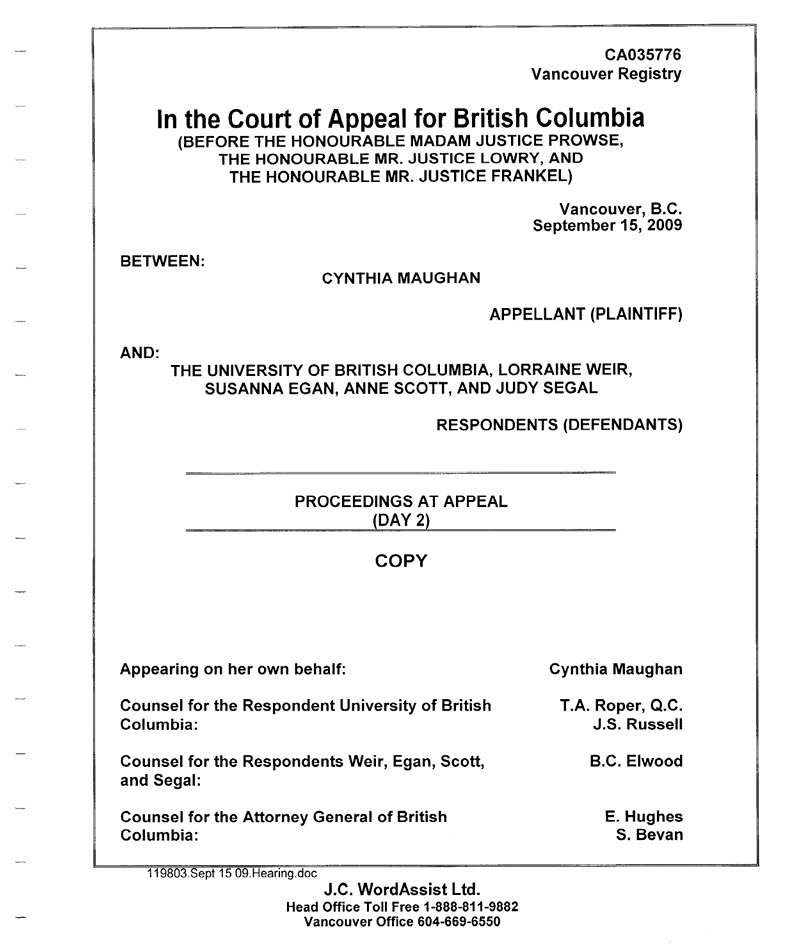
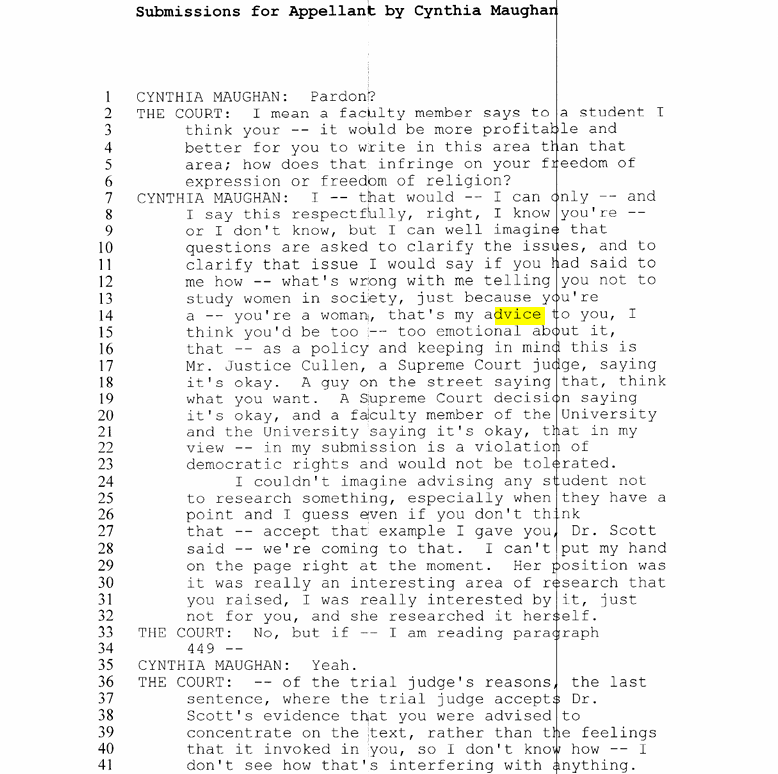
The Academic Double Standard and Equal Charter Protection: The Analogy of Discriminatory Guidance
During oral submissions at the British Columbia Court of Appeal (BCCA), the Appellant challenged the court’s characterization of the faculty’s intervention as benign “academic advice.” The Student exposed an institutional double standard regarding how universities treat different Charter-protected grounds:
- Protected Interdisciplinarity: Modern universities dedicate entire academic departments to scholarly research centered on protected grounds like gender, encouraging scholars to engage deeply with texts through the lens of their lived or shared experiences.
- The Religious Exclusion: In contrast, when a religious student applies rigorous, objective textual analysis to a theological error—such as Derrida misquoting scripture—the institution arbitrarily pathologizes the research, labeling it an inappropriate expression of personal “feelings.”
The Student argued that a faculty member advising a student away from valid theological research under the guise of protecting them from their “feelings” is functionally identical to an advisor telling a female student to avoid gender studies because she might be “too emotional.” If the latter is recognized as an intolerable violation of democratic rights and academic freedom, the former must be held to the exact same Charter standard.
Notably, the student’s linguistic research paper was rated in the outstanding category by the Instructor in the first assessment; on the face of it, the research paper says nothing about personal religious feelings; and the motivation for the paper is documented to have been strictly academic in the Student Witness Senate Letter
1 CYNTHIA MAUGHAN: Pardon?
2 THE COURT: I mean a faculty member says to a student I
3 think your — it would be more profitable and
4 better for you to write in this area than that
5 area; how does that infringe on your freedom of
6 expression or freedom of religion?
7 CYNTHIA MAUGHAN: I — that would — I can only — and
8 I say this respectfully, right, I know you’re —
9 or I don’t know, but I can well imagine that
10 questions are asked to clarify the issues, and to
11 clarify that issue I would say if you had said to
12 me how — what’s wrong with me telling you not to
13 study women in society, just because you’re
14 a — you’re a woman, that’s my advice to you, I
15 think you’d be too — too emotional about it,
16 that — as a policy and keeping in mind this is
17 Mr. Justice Cullen, a Supreme Court judge, saying
18 it’s okay. A guy on the street saying that, think
19 what you want. A Supreme Court decision saying
20 it’s okay, and a faculty member of the University
21 and the University saying it’s okay, that in my
22 view — in my submission is a violation of
23 democratic rights and would not be tolerated.
24 I couldn’t imagine advising any student not
25 to research something, especially when they have a
26 point and I guess even if you don’t think
27 that — accept that example I gave you, Dr. Scott
28 said — we’re coming to that. I can’t put my hand
29 on the page right at the moment. Her position was
30 it was really an interesting area of research that
31 you raised, I was really interested by it, just
32 not for you, and she researched it herself.
33 THE COURT: No, but if — I am reading paragraph
34 449 —
35 CYNTHIA MAUGHAN: Yeah.
36 THE COURT: — of the trial judge’s reasons, the last
37 sentence, where the trial judge accepts Dr.
38 Scott’s evidence that you were advised to
39 concentrate on the text, rather than the feelings
40 that it invoked in you, so I don’t know how — I
41 don’t see how that’s interfering with anything.
You must be logged in to post a comment.