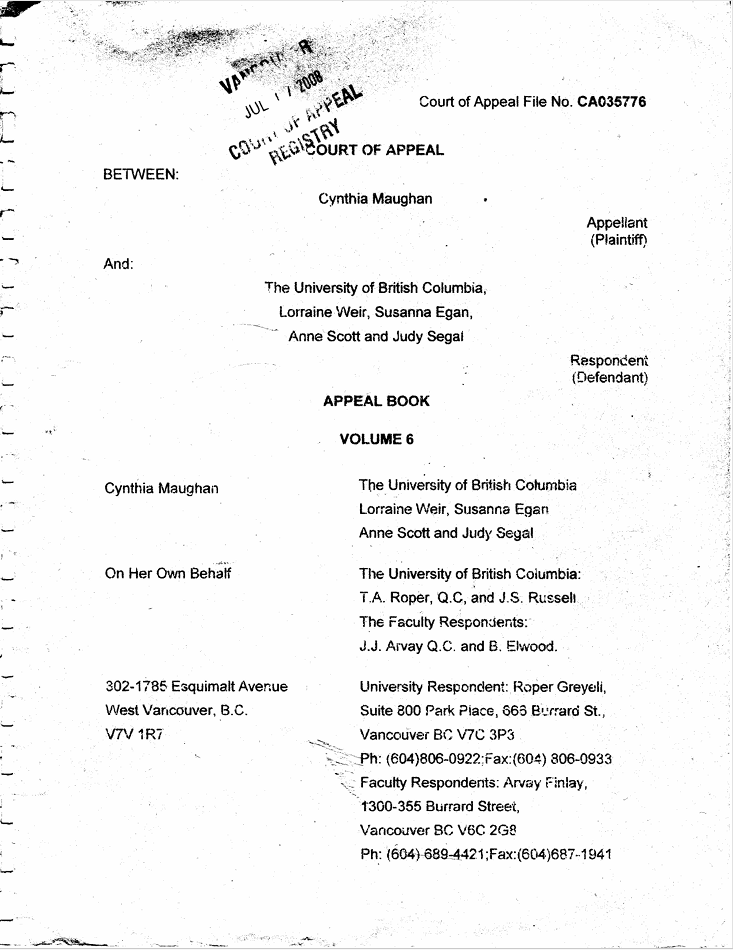
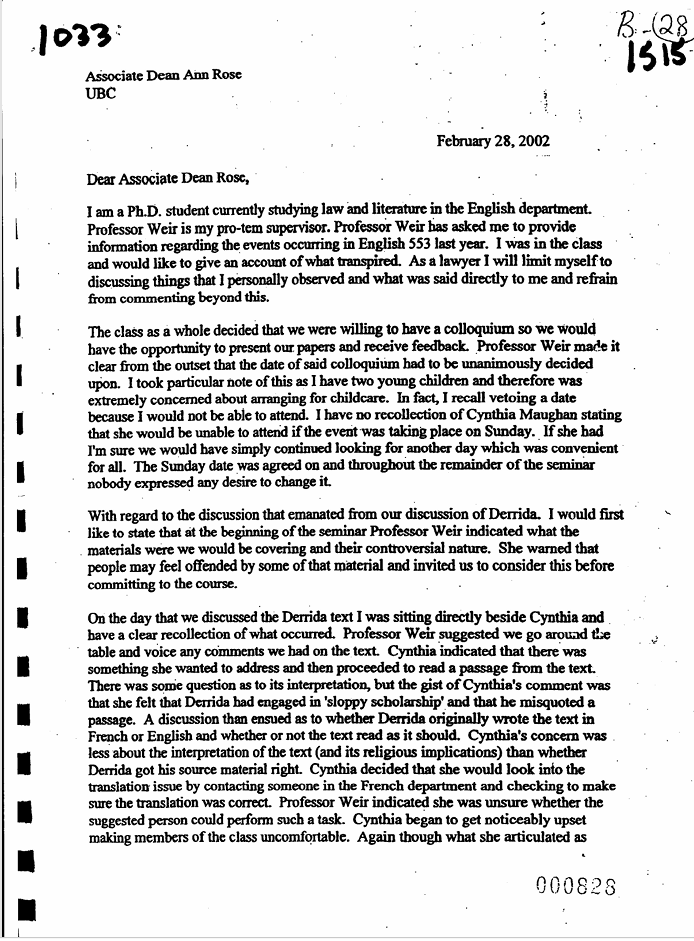
The Evidentiary Record: A formal submission sent to the Associate Dean of Graduate Studies on February 28, 2002, by a Ph.D. student peer witness on behalf of the seminar instructor. The letter was later formally entered into the BCSC trial record as primary evidence.
The Critical Contradiction: This internal institutional record exposes a fundamental contradiction at the core of the university’s defense. Throughout the litigation, the administration and lower courts maintained that the plaintiff’s classroom actions were an emotional, hypersensitive reaction driven by thin-skinned religious sensitivities.
However, the instructor’s student witness, writing as a lawyer, documented that in fact:
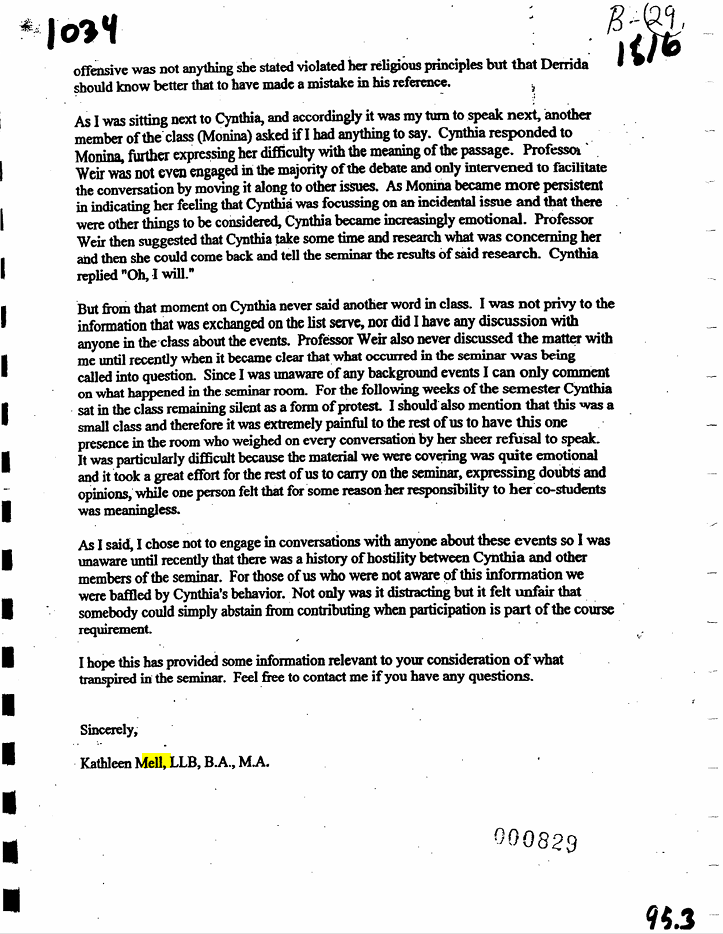
“what she [Ms. Maughan] articulated as offensive was not anything she stated violated her religious principles but that Derrida should know better that to have made a mistake in his reference.”
The Legal Connection to Amselem: Under the Amselem doctrine, the legal system and public bodies are strictly barred from evaluating, pathologizing, or defining the nature of an adherent’s faith or conduct during a dispute.
By ignoring their own primary eyewitness record—which confirmed the plaintiff was engaged in a standard, source-based academic debate regarding translation accuracy—the university administration pathologized a rigorous scholarly critique into proof of a religious “overreaction.” This institutional framing directly laid the groundwork for the trial court to step outside the protective bounds of Amselem and evaluate the claimant’s psychological state rather than the university’s absolute failure to accommodate a holy day conflict.
Verbatim Transcription: Senate Submission Page 1
Student Witness Senate Letter
1463
[redacted]
UBC
February 28, 2002
Dear [redacted],
I am a Ph.D. student currently studying law and literature in the English department. Professor Weir is my pro-tem supervisor. Professor Weir has asked me to provide information regarding the events occurring in English 553 last year. I was in the class and would like to give an account of what transpired. As a lawyer I will limit myself to discussing things that I personally observed and what was said directly to me and refrain from commenting beyond this.
The class as a whole decided that we were willing to have a colloquium so we would have the opportunity to present our papers and receive feedback. Professor Weir made it clear from the outset that the date of said colloquium had to be unanimously decided upon. I took particular note of this as I have two young children and therefore was extremely concerned about arranging for childcare. In fact, I recall vetoing a date because I would not be able to attend. I have no recollection of Cynthia Maughan stating that she would be unable to attend if the event was taking place on Sunday. If she had I’m sure we would have simply continued looking for another day which was convenient for all. The Sunday date was agreed on and throughout the remainder of the seminar nobody expressed any desire to change it.
With regard to the discussion that emanated from our discussion of Derrida. I would first like to state that at the beginning of the seminar Professor Weir indicated what the materials were we would be covering and their controversial nature. She warned that people may feel offended by some of that material and invited us to consider this before committing to the course.
On the day that we discussed the Derrida text I was sitting directly beside Cynthia and have a clear recollection of what occurred. Professor Weir suggested we go around the table and voice any comments we had on the text. Cynthia indicated that there was something she wanted to address and then proceeded to read a passage from the text. There was some question as to its interpretation, but the gist of Cynthia’s comment was that she felt that Derrida had engaged in ‘sloppy scholarship’ and that he misquoted a passage. A discussion than ensued as to whether Derrida originally wrote the text in French or English and whether or not the text read as it should. Cynthia’s concern was less about the interpretation of the text (and its religious implications) than whether Derrida got his source material right. Cynthia decided that she would look into the translation issue by contacting someone in the French department and checking to make sure the translation was correct. Professor Weir indicated she was unsure whether the suggested person could perform such a task. Cynthia began to get noticeably upset making members of the class uncomfortable. Again though what she articulated as
91.3
Verbatim Transcription: Senate Submission Page 2
1464
offensive was not anything she stated violated her religious principles but that Derrida should know better that to have made a mistake in his reference.
As I was sitting next to Cynthia, and accordingly it was my turn to speak next, another member of the class (Monina) asked if I had anything to say. Cynthia responded to Monina, further expressing her difficulty with the meaning of the passage. Professor Weir was not even engaged in the majority of the debate and only intervened to facilitate the conversation by moving it along to other issues. As Monina became more persistent in indicating her feeling that Cynthia was focussing on an incidental issue and that there were other things to be considered, Cynthia became increasingly emotional. Professor Weir then suggested that Cynthia take some time and research what was concerning her and then she could come back and tell the seminar the results of said research. Cynthia replied “Oh, I will.”
But from that moment on Cynthia never said another word in class. I was not privy to the information that was exchanged on the list serve, nor did I have any discussion with anyone in the class about the events. Professor Weir also never discussed the matter with me until recently when it became clear that what occurred in the seminar was being called into question. Since I was unaware of any background events I can only comment on what happened in the seminar room. For the following weeks of the semester Cynthia sat in the class remaining silent as a form of protest. I should also mention that this was a small class and therefore it was extremely painful to the rest of us to have this one presence in the room who weighed on every conversation by her sheer refusal to speak. It was particularly difficult because the material we were covering was quite emotional and it took a great effort for the rest of us to carry on the seminar, expressing doubts and opinions, while one person felt that for some reason her responsibility to her co-students was meaningless.
As I said, I chose not to engage in conversations with anyone about these events so I was unaware until recently that there was a history of hostility between Cynthia and other members of the seminar. For those of us who were not aware of this information we were baffled by Cynthia’s behavior. Not only was it distracting but it felt unfair that somebody could simply abstain from contributing when participation is part of the course requirement.
I hope this has provided some information relevant to your consideration of what transpired in the seminar. Feel free to contact me if you have any questions.
Sincerely,
[redacted] LLB, B.A., M.A.
91.3
The Critical Contradiction: This internal institutional record exposes a fundamental contradiction at the core of the university’s defense. Throughout the litigation, the administration and lower courts maintained that the plaintiff’s classroom actions were an emotional, hypersensitive reaction driven by thin-skinned religious sensitivities.
However, the instructor’s own student witness—writing with the explicit professional boundaries of a lawyer—documented the exact opposite:
“Cynthia’s concern was less about the interpretation of the text (and its religious implications) than whether Derrida got his source material right.” (Page 1)
“…what she articulated as offensive was not anything she stated violated her religious principles but that Derrida should know better that to have made a mistake in his reference.” (Page 2)
The Legal Application: This primary source proves that the plaintiff was engaging in objective, factual, and source-based academic criticism regarding a textual translation error. It establishes that she did not bring her personal theological principles into the classroom discussion.
Despite this documentation being part of the university’s own records, the institution recharacterized this rigorous scholarly critique into proof of an unstable religious “overreaction.” This institutional pathologizing laid the groundwork for the trial court to step outside the protective bounds of Amselem, using the student’s subsequent silent protest to justify an unauthorized judicial evaluation of her psychological state rather than addressing the university’s absolute failure to accommodate a holy day conflict.
You must be logged in to post a comment.